
The Definitive Guide: Best Coffee Beans for French Press (2026 Edition)
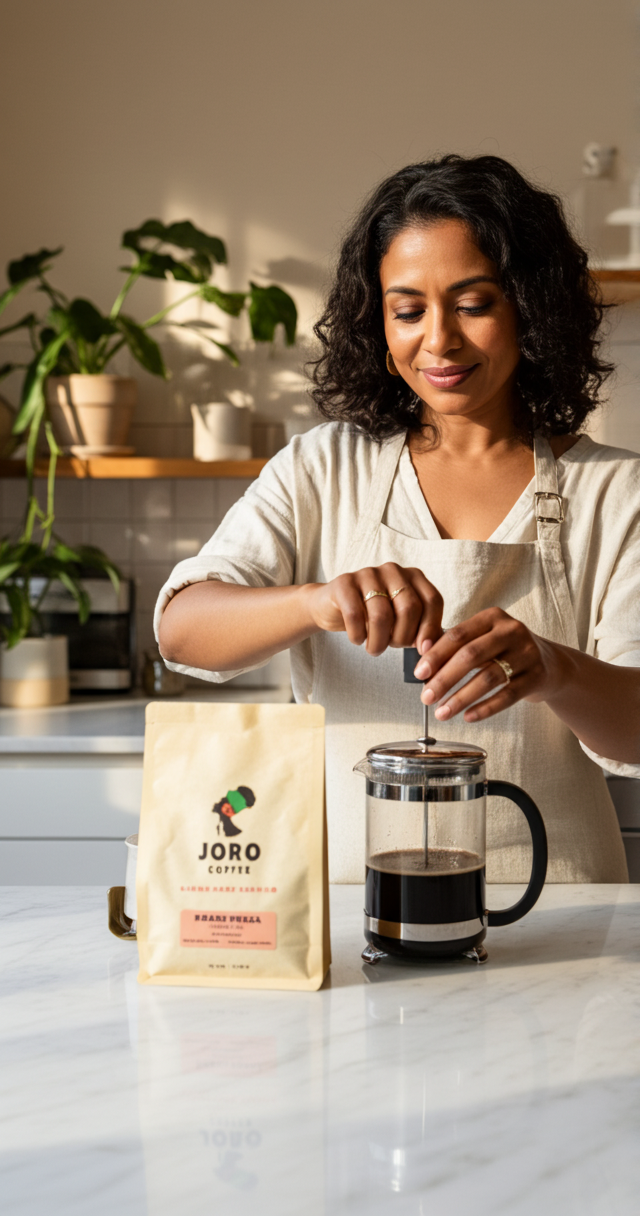
Why Your French Press Tastes "Off"
You love the ritual of the French Press-the plunging, the weight of the carafe, the aroma. But more often than not, your morning cup ends up either bitter and over-extracted or thin and sour.
In 2026, the "standard" grocery store bean just doesn't cut it. Most mass-produced beans are roasted too oily, which clogs your mesh filter, or too light, leaving your coffee tasting like grassy water.
The "Immersion" Factor
Unlike a pour-over, the French Press is an immersion brewing method. This means your coffee grounds sit in hot water for the entire duration of the brew (usually 4–5 minutes).
If you use a high-acid, light-roast bean meant for a Chemex, the immersion process often fails to develop the sugars, leaving you with a cup that lacks body. Conversely, a "Charcoal" dark roast becomes a bitter mess after 4 minutes of bathing in 200 degrees!.
Why African Beans are the 2026 French Press King
Through our data-driven cupping sessions at Joro, we have identified that the best coffee beans for French Press in 2026 come from high-altitude African regions-specifically Uganda and Ethiopia-roasted to a precise Medium-Dark profile.
1. Ugandan Arabica (The Body Builder)
Ugandan beans, particularly from the Mount Elgon region, have a naturally higher density. In a French Press, this density translates to a "syrupy" mouthfeel.
• Flavor Profile: Dark chocolate, dried plum, and a hint of forest honey.
• Why it works: It holds its structural integrity during long immersion times.
2. Ethiopian Beans (The Aromatic Heavyweight)
While many think of Ethiopia for light roasts, a medium-dark Sidamo is a revelation in a press. It provides the "funk" and floral notes people love, but with enough roast development to provide a creamy finish.
Pillars of the Perfect 2026 French Press Brew
To get the most out of Joro’s African beans, follow these updated SEO-backed guidelines:
I. The "Coarse-Salt" Consistency
Your grind size is non-negotiable. For a French Press, you need a coarse grind (roughly 1,000 to 1,200 microns).
• Pro Tip: If your plunger is hard to push down, your grind is too fine. If it falls to the bottom with no resistance, it’s too coarse.
II. The 2026 "No-Stir" Method
Recent brewing science suggests that stirring your French Press immediately after pouring creates too many "fines" (micro-particles), leading to silt in your cup. Instead:
1. Pour your water
2. Let it sit for 4 minutes.
3. Gently break the "crust" on top with a spoon—don't churn the bottom.
III. The Water-to-Coffee Ratio
For African beans, we recommend the Golden Ratio of 1:15.
• Example: 30g of Ngoma Coffee (Uganda) to 450g of water.
Why Ngoma Coffee is Our #1 Pick for 2026
Our Ngoma Coffee from Uganda is a medium-dark roast engineered for the French Press. Because we source directly from organic-certified farmers, the beans retain their natural oils. When brewed in a metal mesh filter (rather than paper), these oils pass through into your cup, creating a luxurious, velvety texture that you simply can't get with a drip machine.
"Joro has managed to capture the wildness of African coffee but tamed it for the French Press. It’s the richest cup I’ve had this year." – 2026 Specialty Coffee Review
Ready to level up your morning?

Uganda produces some of East Africa’s finest arabica.
The world just hasn’t been paying attention — yet.
Grown in Uganda’s high-altitude regions where elevation exceeds 1,500 metres and volcanic soil produces the same slow cherry maturation that makes Ethiopian coffee celebrated globally, Ngoma is named for the traditional East African drum. A ngoma gathering is a community event. That’s the spirit this coffee carries.
In the cup: vivid berry notes open the first sip, a smooth caramel warmth builds through the body, and a clean finish lingers without bitterness. Ngoma is one of the most approachable origins in the Joro lineup — the coffee that changes people’s minds about what specialty coffee can taste like.
About 29 to 32 percent of Uganda’s coffee qualifies as specialty grade. Ngoma is from that fraction. Smallholder farmers, hand-harvesting at altitude, delivering cherries to co-operative washing stations that have invested in quality over the past decade.
Living Wage Verified. Every bag. Every harvest.
✔ Single origin · Uganda
✔ Medium roast · Whole bean · 12oz
✔ Tasting notes: berries, caramel, clean finish
✔ Living Wage Verified
✔ Compostable packaging
✔ From African soil to your cup
Additional Info
ORIGIN: Uganda high-altitude growing regions
ALTITUDE: 1,500–2,000 metres
PROCESS: Washed
ROAST: Medium
TASTING NOTES: Berries, caramel, clean finish
BEST FOR: Cold brew, pour-over, Aeropress
BREW GUIDE
Cold brew (recommended): 75g coarsely ground per 1 litre cold water. Steep 16–18 hours refrigerated. The berry and caramel notes amplify beautifully in slow extraction. Serve over ice, no sweetener needed.
Pour-over: 20g coffee, 300ml water at 93°C, medium-fine grind. Bloom 30 seconds. The berry brightness comes through clearly in filter brewing.
FOUNDER NOTE
When Mukurima sources from Uganda, he sees a country whose coffee has been undervalued for decades — and whose farmers produce cups that rival anything on the continent. Ngoma is Joro’s statement that Uganda belongs in the conversation.